George Oppen
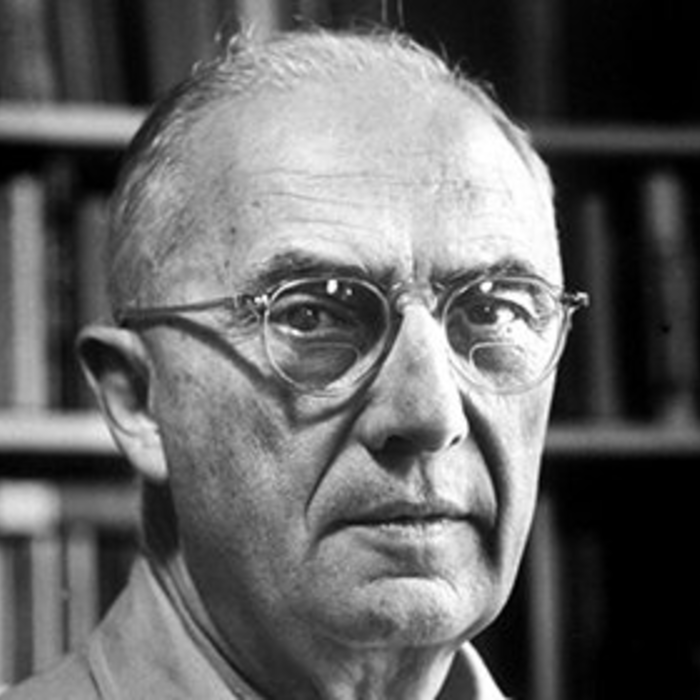
George Oppen was born on April 24, 1908, in New Rochelle, New York, to Elsie Rothfeld and George Oppenheimer (the family changed their name to Oppen in 1927). His father was a diamond merchant, and the family lived a comfortable, affluent lifestyle, which included servants and sailing lessons, a fact that conflicted with the strong identification with the working class that Oppen developed later in life. After suffering mental problems and a nervous breakdown, Oppen’s mother committed suicide when Oppen was four. His father married Selville Shainwald when Oppen was seven. She was a wealthy and ambitious woman with whom Oppen had a difficult and painful relationship that haunted him through his adulthood.
The family moved cross-country to San Francisco in 1917. Oppen attended Warren Military Academy, where he was unhappy and began drinking and engaging in reckless behavior, including fighting. He was expelled from school after a serious car crash in which he was driving and witnessed the death of a young passenger. He then traveled to England and Scotland, attending philosophy lectures and visiting relatives.
Oppen moved back to the United States in 1926, and began attending Oregon State Agricultural College (now Oregon State University), where he met Mary Colby. After spending the night together away from campus, she was expelled and he was suspended. The two left Oregon, got married, and began a sailing and hitchhiking trip from the West Coast to New York City. Once they arrived in New York, Oppen met poet Louis Zukofsky and soon became a central member of the Objectivist poets that flourished in the 1930s.
In 1929, Oppen inherited a small sum of money which allowed him and Zukofsky to start a small publishing venture. To Publishers, with Zukofsky as editor, published work by William Carlos Williams and Ezra Pound, but the magazine was short-lived. The famous Objectivist Anthology which contained writing by Williams, Pound, Marianne Moore, Charles Reznikoff, and Kenneth Rexroth was published by the Oppens in Toulon, France, in 1932.
After traveling to California and living in France, the Oppens returned to New York where, along with Zukofsky, Williams, and Reznikoff, they began the Objectivist Press. Oppen’s first book of poetry, Discrete Series (Objectivist Press), was published, with a preface by Ezra Pound, in 1934. That same year, the press published Williams’s Collected Poems, 1921–1931.
In his introduction to Oppen’s Selected Poems (New Directions, 2003), poet Robert Creeley writes about the Objectivist group:
However different they were later to find their lives—particularly so in the instance of Oppen and Zukofsky—all worked from the premise that poetry is a function of perception, ‘of the act of perception,’ as Oppen emphasizes in his one defining essay, ‘The Mind’s Own Place.’ Oppen’s complex ‘thinking with his poems’ is a consistent and major factor in all his surviving work […] I think much becomes clear, in fact, if one recognizes that George Oppen is trying all his life to think the world, not only to find or to enter it, or to gain a place in it but to realize it, to figure it, to have it literally in mind.
George and Mary Oppen moved increasingly to the political left during the Great Depression, becoming social activists. During this period, Oppen’s poems appeared in small journals such as Active Anthology, Poetry, and Hound and Horn, but he soon gave up writing for more than two decades. Unable to write poetry that he felt adequately reflected the political circumstances, he began working for the Communist Party USA, serving as an election campaign manager in Brooklyn in 1936. Disillusioned with the Party by 1942, Oppen quit his job and volunteered for military service to fight fascism.
Oppen served in World War II, during which he was badly wounded and awarded the Purple Heart. Back in New York, Oppen and his wife found that their politics made their living situation difficult. They were targets of the House of Un-American Activities Committee (HUAC) during the McCarthy era, and ultimately fled to Mexico in 1950, where Oppen started a carpentry business.
Oppen revived his poetic career when he and his wife returned to the United States in 1958. Their daughter was beginning college at Sarah Lawrence College, so the couple moved to Brooklyn, where they were reunited with Zukofsky and Reznikoff. In 1962, New Directions published Oppen’s second book of poetry, The Materials, which was followed by This in Which (New Directions, 1965). In 1969, Of Being Numerous (New Directions, 1968) was awarded the Pulitzer Prize for Poetry. Oppen’s Collected Poems (New Directions, 1976) includes all of the poetry from Discrete Series through Myth of the Blaze (New Directions, 1975). In 1980, he received a fellowship from the National Endowment for the Arts.
About Oppen, poet James Longenbach has written: “Oppen’s respect for the art of making, no matter how small, is at every moment palpable, and it infuses his work with sweetness that makes difficulty feel like life’s reward.”
In the late 1960s, Oppen moved to San Francisco where he became stricken with Alzheimer’s disease. He was able to complete his final work, Primitive, only with his wife Mary’s assistance. He lived in California until his death on July 7, 1984.