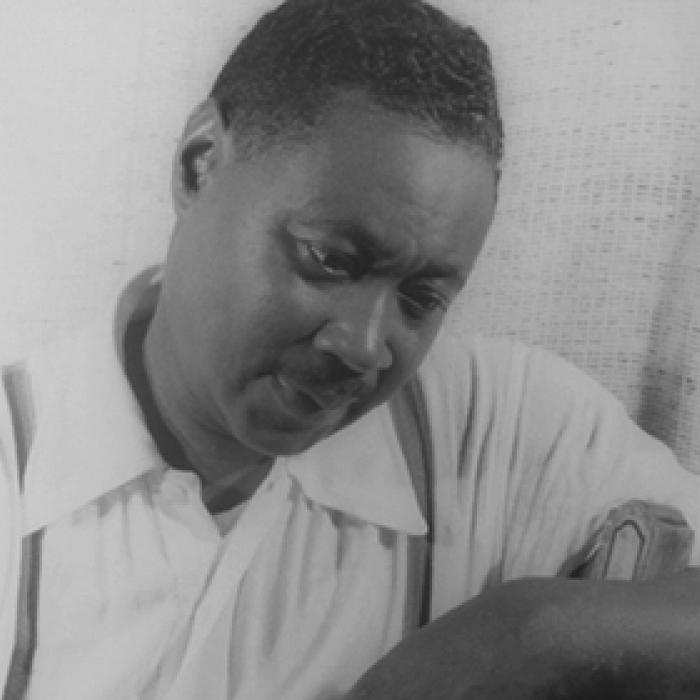
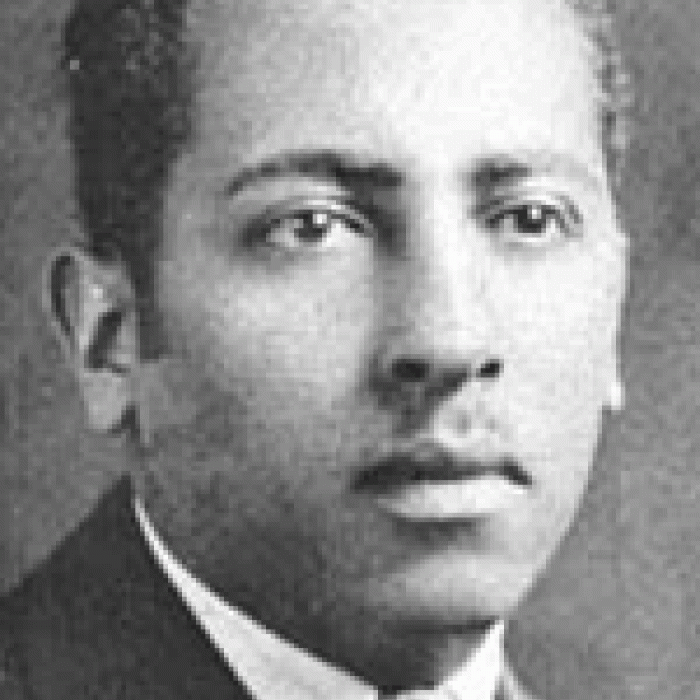
Countee Cullen
Countee Cullen was born Countee LeRoy Porter on May 30, 1903, likely in Louisville, Kentucky. He attended De Witt Clinton High School in New York City and began writing poetry at the age of fourteen. When he was fifteen, he was unofficially adopted by F. A. Cullen, the minister of a Methodist church in Harlem.
Cullen entered New York University after high school. Around the same time, his poems were published in The Crisis, under the leadership of W. E. B. Du Bois, and Opportunity, a magazine published by the National Urban League. Cullen was soon after published in Harper’s, the Century Magazine, and Poetry. He won several awards for his poem, “Ballad of the Brown Girl,” and graduated from New York University in 1925. That same year, he published his first volume of verse, Color (Harper & Bros., 1925), and was admitted to Harvard University, where he completed an MA in English.
Cullen went on to publish several more poetry collections, including On These I Stand: An Anthology of the Best Poems of Countee Cullen (Harper & Bros., 1947); The Black Christ and Other Poems (G. P. Putnam’s Sons, 1929); Copper Sun (Harper & Bros., 1927), and the seminal anthology Caroling Dusk: An Anthology of Verse by Black Poets of the Twenties (Harper & Brothers, 1927). An imaginative lyric poet, Cullen wrote in the Romantic tradition of John Keats and Percy Bysshe Shelley and was resistant to the new poetic techniques of the Modernists; his work demonstrates the range of subjects and aesthetic interests that poets of the Harlem Renaissance addressed.
The poet Major Jackson writes, “Cullen was celebrated as the golden exemplar of a campaign by Black political and cultural leaders who sought to engineer a new image of Black people in America. Yet he was also targeted as an aesthete, and his expressed desire to be read as ‘a poet and not a Negro poet’ was increasingly condemned as representative of black aristocratic self-hatred, and worse, a veiled longing 'to be white.’”
Cullen taught in New York City public schools for twelve years beginning in 1934. He died on January 9, 1946.