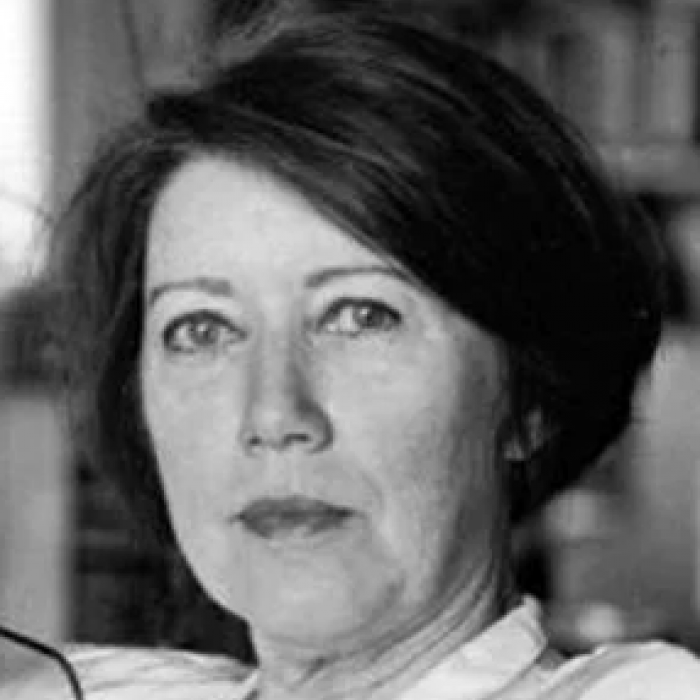
Denise Levertov
Denise Levertov was born in Ilford, Essex, England, on October 24, 1923. Her father, raised a Hasidic Jew, had converted to Christianity while attending university in Germany. By the time Levertov was born, he had settled in England and become an Anglican parson. Her mother, who was Welsh, read authors such as Willa Cather, Joseph Conrad, Charles Dickens, and Leo Tolstoy aloud to the family. Levertov was educated entirely at home and claimed to have decided to become a writer at the age of five. When she was twelve, she sent some of her poetry to T. S. Eliot, who responded with two pages of “excellent advice” and encouragement to continue writing. At seventeen, she had her first poem published, in Poetry Quarterly.
During World War II, Levertov became a civilian nurse serving in London throughout the bombings. She wrote her first book, The Double Image (Cresset Press, 1946), while she was between the ages of seventeen and twenty-one. The book brought her recognition as one of a group of poets dubbed the “New Romantics.”
In 1947, Levertov married Mitchell Goodman, an American writer. A year later, they moved to the United States, settling in New York City and spending summers in Maine. Their son, Nikolai, was born in 1949. She became a naturalized U.S. citizen in 1956.
After her move to the U.S., Levertov was introduced to the Transcendentalism of Ralph Waldo Emerson and Henry David Thoreau, the formal experimentation of Ezra Pound, and, in particular, the work of William Carlos Willams. Through her husband’s friendship with poet Robert Creeley, she became associated with the Black Mountain group of poets, particularly Creeley, Charles Olson, and Robert Duncan, who had formed a short-lived, but groundbreaking, school in 1933 in North Carolina. Some of Levertov’s work was published in the 1950s in the Black Mountain Review. Levertov acknowledged these influences but disclaimed membership in any poetic school. She moved away from the fixed forms of English practice, developing an open, experimental style. With the publication of her first American book, Here and Now (1956), by City Lights Bookstore she became an important voice in the American avant-garde. Her poems of the fifties and sixties won her immediate and excited recognition, not just from peers like Creeley and Duncan, but also from the avant-garde poets of an earlier generation, such as Williams and Kenneth Rexroth.
Levertov’s next book, With Eyes at the Back of our Heads (New Directions, 1959), established her as one of the great American poets, and her British origins were soon forgotten. She was poetry editor of The Nation in 1961 and from 1963 to 1965. During the 1960s, activism and feminism became prominent in her poetry. During this period, she produced one of her most memorable works of rage and sadness, The Sorrow Dance (New Directions, 1967), which encompassed her feelings toward the war and the death of her older sister. She received a fellowship from the National Endowment for the Arts in 1969. From 1975 to 1978, she was poetry editor of Mother Jones magazine.
Levertov went on to publish more than twenty volumes of poetry, including The Freeing of the Dust (New Directions, 1975), which won the Lenore Marshall Poetry Prize. She was also the author of four books of prose, most recently Tesserae (New Directions, 1995), and translator of three volumes of poetry, among them Jean Joubert’s Black Iris (Copper Canyon Press, 1988). From 1982 to 1993, Levertov taught at Stanford University. She spent the last decade of her life in Seattle, during which time she published Sands of the Well (New Directions, 1996); Evening Train (New Directions, 1992); A Door in the Hive (New Directions, 1989); Poems 1968–1972 (New Directions, 1987); and Breathing the Water (J. Laughlin, 1987).
Levertov died in Seattle on December 20, 1997. New Directions published This Great Unknowing: Last Poems in 1999 and The Collected Poems of Denise Levertov in 2013.