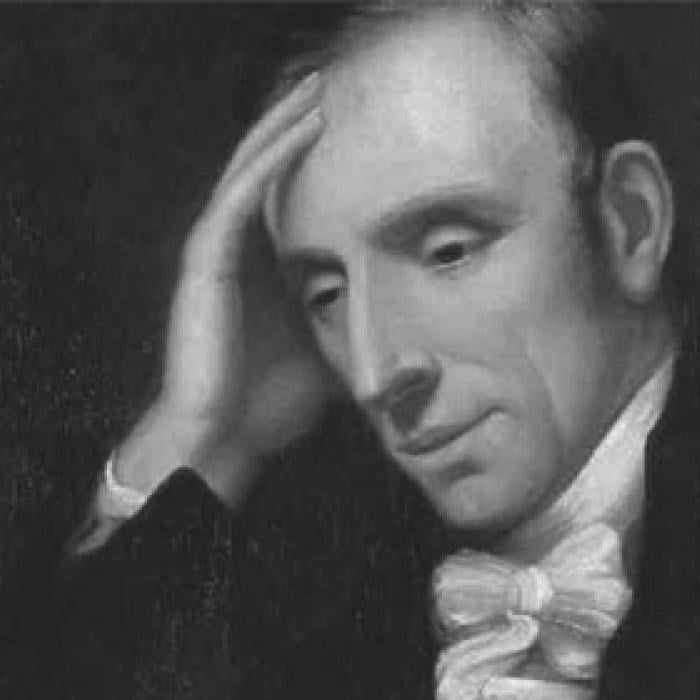
Ralph Waldo Emerson
American poet, essayist, and philosopher Ralph Waldo Emerson was born on May 25, 1803, in Boston. After studying at Harvard and teaching for a brief time, Emerson entered the ministry. He was appointed to the Old Second Church in his native city, but soon became an unwilling preacher. Unable in conscience to administer the sacrament of the Lord’s Soon after the death of his nineteen-year-old wife of tuberculosis, Emerson resigned his pastorate in 1831.
The following year, Emerson sailed for Europe, visiting Thomas Carlyle and Samuel Taylor Coleridge. Carlyle, the Scottish-born English writer, was famous for his explosive attacks on hypocrisy and materialism, his distrust of democracy, and his highly romantic belief in the power of the individual. Emerson’s friendship with Carlyle was both lasting and significant; the insights of the British thinker helped Emerson formulate his own philosophy.
On his return to New England, Emerson became known for challenging traditional thought. In 1835, he married his second wife, Lydia Jackson, and settled in Concord, Massachusetts. Known in the local literary circle as “The Sage of Concord,” Emerson became the chief spokesman for Transcendentalism, the American philosophic and literary movement. Centered in New England during the nineteenth century, Transcendentalism was a reaction against scientific rationalism.
Emerson’s first book, Nature (1836), is perhaps the best expression of his Transcendentalism, the belief that everything in our world—even a drop of dew—is a microcosm of the universe. His concept of the Over-Soul—a Supreme Mind that every man and woman share—allowed Transcendentalists to disregard external authority and to rely instead on direct experience. “Trust thyself,” Emerson’s motto, became the code of Margaret Fuller, Bronson Alcott, Henry David Thoreau, and W. E. Channing. From 1842 to 1844, Emerson edited the Transcendentalist journal, The Dial.
Emerson wrote a poetic prose, ordering his essays by recurring themes and images. His poetry, on the other hand, is often called harsh and didactic. Among Emerson’s most well known works are Essays, First and Second Series (1841, 1844). The First Series includes Emerson's famous essay, “Self-Reliance,” in which the writer instructs his listener to examine his relationship with Nature and God, and to trust his own judgment above all others.
Emerson’s other volumes include Poems (1847), Representative Men (1850), The Conduct of Life (1860), and English Traits (1865). His best-known addresses are The American Scholar (1837) and The Divinity School Address, which he delivered before the graduates of the Harvard Divinity School, shocking Boston’s conservative clergymen with his descriptions of the divinity of man and the humanity of Jesus.
Emerson’s philosophy is characterized by its reliance on intuition as the only way to comprehend reality, and his concepts owe much to the works of Plotinus, Emanuel Swedenborg, and Jakob Böhme. A believer in the “divine sufficiency of the individual,” Emerson was a steady optimist. His refusal to grant the existence of evil caused Herman Melville, Nathaniel Hawthorne, and Henry James, Sr., among others, to doubt his judgment. In spite of their skepticism, Emerson’s beliefs are of central importance in the history of American culture.
Ralph Waldo Emerson died of pneumonia on April 27, 1882.