Robert Graves
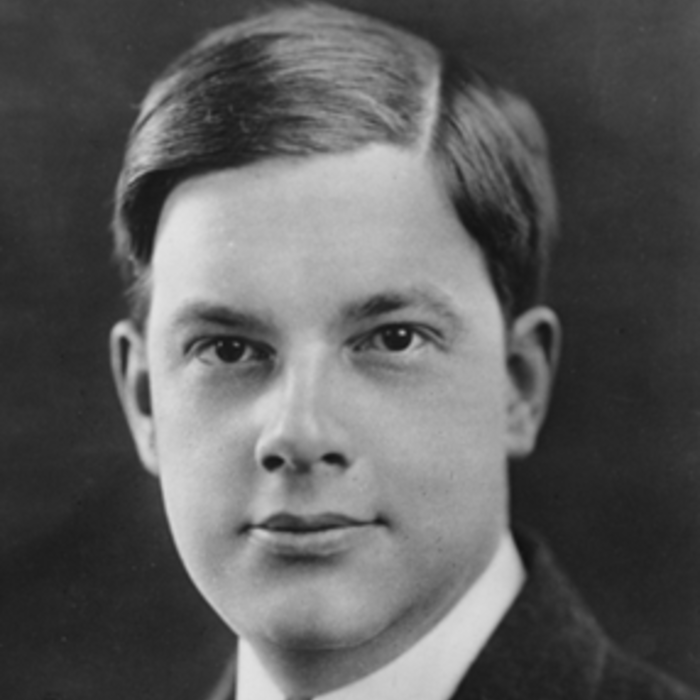
Robert Graves was born in Wimbledon, near London, on July 24, 1895. His father, Alfred Perceval Graves, was a Gaelic scholar and minor Irish poet. His mother, Amalie von Ranke Graves, was a relation of Leopold von Ranke, one of the founding fathers of modern historical studies. One of ten children, Robert was greatly influenced by his mother’s puritanical beliefs and his father’s love of Celtic poetry and myth. As a young man, he was more interested in boxing and mountain climbing than studying, although poetry later sustained him through a turbulent adolescence.
In 1913 Graves won a scholarship to continue his studies at St. John’s College, Oxford. In August 1914, he enlisted as a junior officer in the Royal Welch Fusiliers. He fought in the Battle of Loos and was injured in the Somme offensive in 1916. While convalescing, he published his first collection of poetry, Over the Brazier (The Poetry Bookshop). By 1917, though still an active serviceman, Graves had published three volumes. In 1918, he spent a year in the trenches, where he was again severely wounded.
Traumatized by the war, he went to Oxford and took a position at St. John’s College. Graves’s early volumes of poetry, like those of his contemporaries, deal with natural beauty and bucolic pleasures, as well as with the consequences of the First World War. Over the Brazier and Fairies and Fusiliers, published by Heinemann in London in 1917 and Alfred A. Knopf in New York in 1918, earned Graves his reputation as an accomplished war poet. After meeting the American poet and theorist Laura Riding in 1926, Graves’s poetry underwent a significant transformation. Douglas Day has written that the “influence of Laura Riding is quite possibly the most important single element in [Graves’s] poetic career: she persuaded him to curb his digressiveness and his rambling philosophizing and to concentrate instead on terse, ironic poems written on personal themes.”
In 1929, Graves published Goodbye to All That, an autobiography that announced his psychological accommodation with the residual horror of his war experiences. Shortly afterward, he departed to Majorca with Riding. In addition to completing many books of verse while there, Graves also wrote several volumes of criticism, some in collaboration with Riding. The couple cofounded Seizin Press in 1928 and Epilogue, a semiannual magazine, in 1935. During that period, he evolved his theory of poetry as spiritually cathartic to both the poet and the reader. Although Graves claimed that he wrote novels only to earn money, it was through these that he attained status as a major writer in 1934, with the publication of the historical novel I, Claudius, and its sequel, Claudius the God and His Wife Messalina. During the 1970s, the BBC adapted the novels into an internationally popular television series.
At the onset of the Spanish Civil War in 1936, Graves and Riding fled Majorca, eventually settling in America. In 1939, Riding left Graves for the writer Schuyler Jackson. It was in the 1940s, after his break with Riding, that Graves formulated his personal mythology of the White Goddess. Inspired by late nineteenth-century studies of matriarchal societies and goddess cults, this mythology was to pervade all of his later work.
After World War II, Graves returned to Majorca, where he continued to write. By the 1950s, Graves had won an enormous international reputation as a poet, novelist, literary scholar, and translator. In 1962, W. H. Auden went as far as to assert that Graves was England’s “greatest living poet.” In 1968, he received the Queen’s Gold Medal for Poetry. During his lifetime he published more than one hundred and forty books, including fifty-five collections of poetry (he reworked his Collected Poems repeatedly during his career), fifteen novels, ten translations, and forty works of nonfiction, autobiography, and literary essays. From 1961 to 1966, Graves returned to England to serve as a professor of poetry at Oxford. In the 1970s, his productivity fell off, and the last decade of his life was lost in silence and senility.
Robert Graves died in Majorca in 1985.