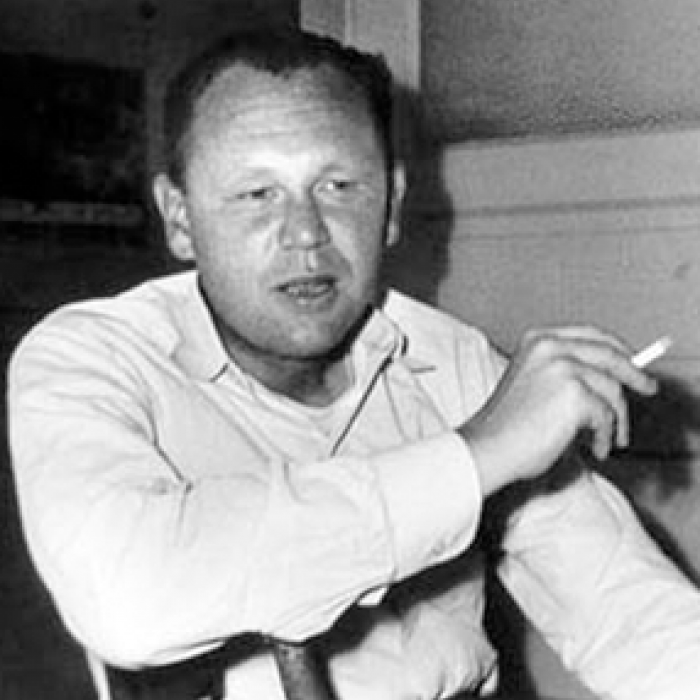
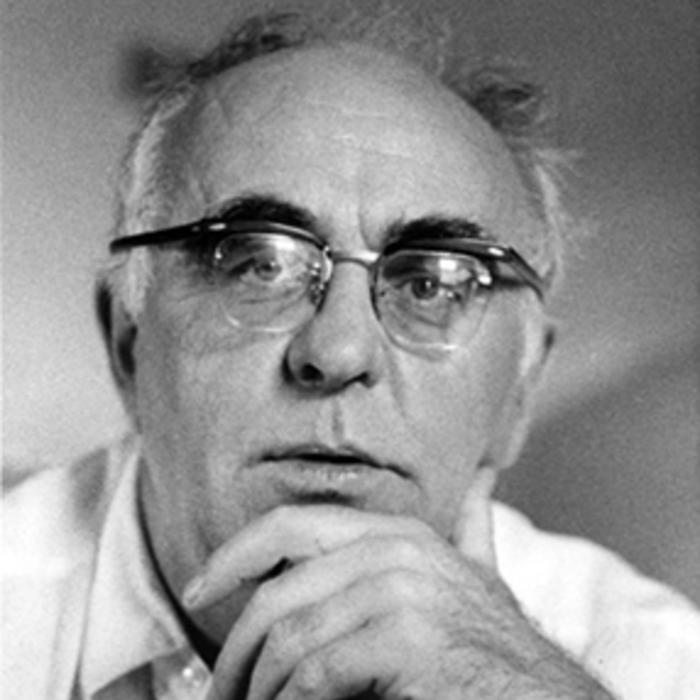
Robert Duncan
Born on January 7, 1919, in Oakland, California, Robert Duncan began writing poetry as a teenager in Bakersfield, when a high school teacher encouraged his creative endeavors. In 1938, after two years at University of California, Berkeley, Duncan moved to New York and became involved in the downtown literary coterie that had sprung up around Anaïs Nin.
While in New York, Duncan took an active role in emerging arts movements, following the works of the Abstract Expressionists, the development of Pablo Picasso’s brand of modernism, and the emergence of an American Surrealism as seen in the works of his acquaintances Roberto Matta and Hans Hoffman. During this time, Duncan launched the Experimental Review with Sanders Russell; Duncan and Russell published the work of Henry Miller, Anaïs Nin, Kenneth Patchen, Lawrence Durrell, and other writers in their circle.
Duncan returned to Berkeley in 1946. The poetry scene there was developing into what would soon be called the San Francisco Renaissance: Jack Spicer and Robin Blaser were together devising their concept of a “serial form” for poems linked by repeating themes, images, and phrases, while Kenneth Rexroth was holding his literary and anarchist meetings, which Duncan, Blaser, and a host of others attended.
In 1947, Duncan met Charles Olson and, over the years that followed, the two developed a relationship rooted in their literary interests. Olson introduced Duncan to Robert Creeley and, in 1956, invited Duncan to teach at Black Mountain College. During his time at Black Mountain, Duncan composed most of the poems in his first mature collection of poetry, The Opening of the Field (New Directions Publishing, 1973). Indeed, Olson’s theory of “projective verse“ and “open forms,” which propose a poetry shaped by the poet’s “breath” rather than by the traditional rules of meter and rhyme, seem to have directly influenced Duncan’s “grand collage” concept of verse. Duncan, in effect, took Olson’s idea of “breath” one step further, presenting the poem as a “compositional field” to which the poet might bring whatever he or she pleases.
Duncan’s rather spiritual upbringing shaped the scope of the poet’s work. After his biological mother died giving birth to him, Duncan was adopted by a couple who practiced theosophy, an occult religion popularized in the late nineteenth century by a controversial figure who called herself Madame Blavatsky (W. B. Yeats was a follower of theosophy, in its early stages). Theosophy, which promotes belief in reincarnation and an “essential oneness” of spirit, draws from world religions and philosophy. Duncan’s adoptive parents, spiritual-seekers who seriously pursued their interests in enlightenment, selected Robert based on the configuration of his astrological chart. Duncan took his parents’ beliefs quite seriously; the occult, in particular, informed both his poetry and theories of poetics throughout his life.
Despite his affiliation with several major movements in American poetry of the fifties and sixties, Duncan forged a style uniquely his own. Utilizing archaic diction and spelling, and complex repetition of phrase, Duncan creates a poetic space both ethereal and obsessive. Throughout his life Duncan became increasingly interested in the writing process, striving to write poems of a purely organic form. His most famous poem, the central piece of The Opening of the Field, provides a commentary on Duncan’s work as a whole, and serves as a precursor for his work to come:
OFTEN I AM PERMITTED TO RETURN TO A MEADOW as if it were a scene made-up by the mind, that is not mine, but is a made place, that is mine, it is so near to the heart, an eternal pasture folded in all thought so that there is a hall therein that is a made place, created by light wherefrom the shadows that are forms fall.
Duncan died on February 3, 1988.