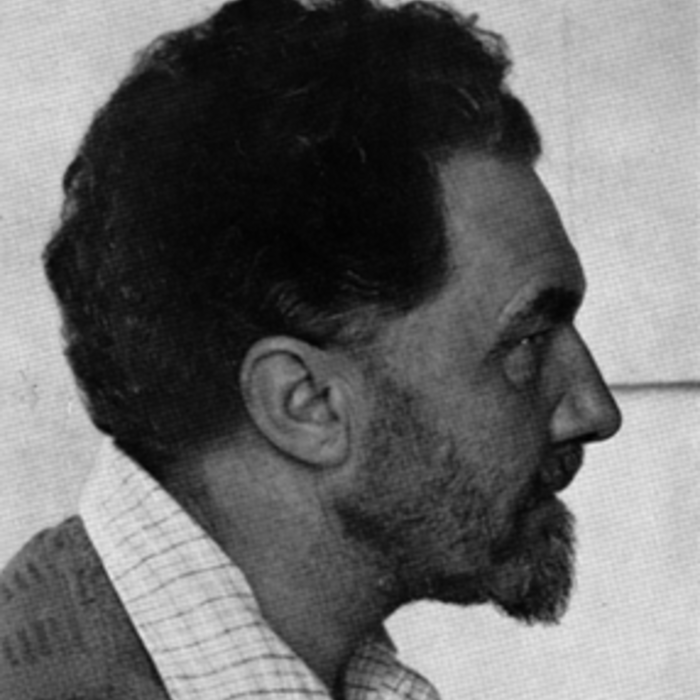
W. H. Auden
Wystan Hugh Auden was born in York, England, on February 21, 1907. He moved to Birmingham during childhood and was educated at Christ Church, Oxford. As a young man he was influenced by the poetry of Thomas Hardy and Robert Frost, as well as William Blake, Emily Dickinson, Gerard Manley Hopkins, and Old English verse. At Oxford, his precocity as a poet was immediately apparent, and he formed lifelong friendships with two fellow writers, Stephen Spender and Christopher Isherwood.
In 1928, Auden’s collection, Poems, was privately printed, but it wasn’t until 1930, when another collection titled Poems (though its contents were different) was published, that Auden was established as the leading voice of a new generation.
Ever since, Auden has been admired for his unsurpassed technical virtuosity and an ability to write poems in nearly every imaginable verse form; the incorporation in his work of popular culture, current events, and vernacular speech; and also for the vast range of his intellect, which drew easily from an extraordinary variety of literatures, art forms, social and political theories, and scientific and technical information. He had a remarkable wit, and often mimicked the writing styles of other poets such as Dickinson, W. B. Yeats, and Henry James. His poetry frequently recounts, literally or metaphorically, a journey or quest, and his travels provided rich material for his verse.
Auden visited Germany, Iceland, and China, served in the Spanish Civil War, and, in 1939, moved to the United States, where he met his lover, Chester Kallman, and became an American citizen. His own beliefs changed radically between his youthful career in England, when he was an ardent advocate of socialism and Freudian psychoanalysis, and his later phase in America, when his central preoccupation became Christianity and the theology of modern Protestant theologians. A prolific writer, Auden was also a noted playwright, librettist, editor, and essayist. Generally considered the greatest English poet of the twentieth century, his work has exerted a major influence on succeeding generations of poets on both sides of the Atlantic.
W. H. Auden served as a Chancellor of the Academy of American Poets from 1954 to 1973, and divided most of the second half of his life between residences in New York City and Austria. He died in Vienna on September 29, 1973.