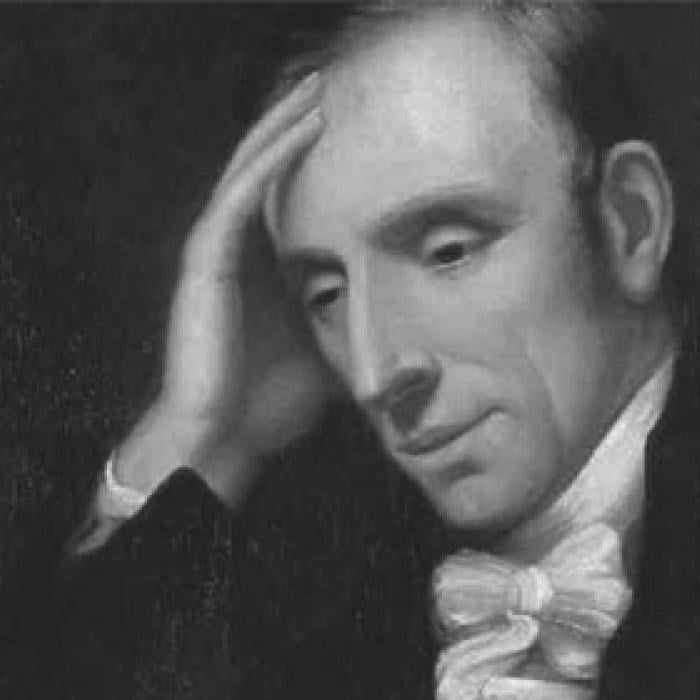
W. B. Yeats
Born in Sandymount, Dublin, Ireland, on June 13, 1865, William Butler Yeats was the son of the well-known Irish painter, John Butler Yeats. He spent his childhood in County Sligo, where his parents were raised, and in London. He returned to Dublin at the age of fifteen to continue his education and to study painting, but quickly discovered that he preferred poetry. Born into the Anglo-Irish landowning class, Yeats became involved with the Celtic Revival, a movement against the cultural influences of English rule in Ireland during the Victorian period, which sought to promote the spirit of Ireland’s native heritage. Though Yeats never learned Irish Gaelic himself, his writing at the turn of the century drew extensively from sources in Irish mythology and folklore. Also a potent influence on his poetry was the Irish revolutionary, Maud Gonne, whom he met in 1889, a woman equally famous for her passionate nationalist politics and her beauty. Though she married another man in 1903 and grew apart from Yeats (and Yeats himself was eventually married to another woman, Georgie Hyde Lees), she remained a powerful figure in his poetry.
Yeats was deeply involved in politics in Ireland and, in the twenties, despite Irish independence from England, his verse reflected a pessimism about the political situation in Ireland and the rest of Europe, paralleling the increasing conservatism of his American counterparts in London, T. S. Eliot and Ezra Pound. His work after 1910 was strongly influenced by Pound, becoming more modern in its concision and imagery, but Yeats never abandoned his strict adherence to traditional verse forms. He had a life-long interest in mysticism and the occult, which was off-putting to some readers, but he remained uninhibited in advancing his idiosyncratic philosophy, and his poetry continued to grow stronger as he grew older. Appointed a senator of the Irish Free State in 1922, he is remembered as an important cultural leader, a major playwright (he was one of the founders of the famous Abbey Theatre in Dublin), and as one of the greatest poets in any language of the twentieth century.
William Butler Yeats was awarded the Nobel Prize for Literature in 1923 and died on January 28, 1939, in Roquebrune-Cap-Martin, France.